Household Employee Tax Information for Illinois
This article unpacks everything you need to know about household employee tax information for Illinois—covering federal and state payroll taxes, legal requirements, best practices, and pro tips for nannies, caregivers, housekeepers, and the families who employ them.

If you’re curious about household employee tax information for Illinois, you’re in the right place! In two sentences: This comprehensive guide explains how to stay compliant with Illinois household employee tax rules, including registering as an employer, remitting payroll taxes, filling out the correct forms, and keeping your household running smoothly. Whether you’re hiring a nanny or a housekeeper, or just want to understand “nanny taxes” and domestic payroll requirements, we’ve got you covered in a style that’s easy and always approachable.
Hiring a household employee in Illinois—be it a nanny, home health aide, or housekeeper—comes with important tax and legal responsibilities. The rules for household employee tax information in Illinois can be complex, but this article will walk you through everything from Social Security and Medicare (FICA) taxes, Illinois unemployment contributions, income tax withholding, new hire reporting, and compliance with wage laws. Whether you’re an Illinois resident wanting to properly classify, pay, and file taxes for your domestic employee, or a professional managing household payroll for others, understanding these requirements is essential to avoid fines and keep your home in good legal standing.
Who Is Considered a Household Employee in Illinois?
A household employee is anyone you pay to do domestic work in or around your home, such as a nanny, housekeeper, babysitter, gardener, or caregiver, if you control both what work is done and how it’s done. If the worker supplies their own tools and controls the work independently (like most independent contractors), they are not a household employee.

Key Illinois Household Employer Tax Responsibilities
1. Register as a Household Employer
You must register as a household (domestic) employer with the Illinois Department of Employment Security (IDES) by filing Form UI-1 DOM. Report all newly hired household employees within 20 days of hire.
2. Social Security, Medicare, and Federal Taxes
- If you pay any household employee at least $2,800 in 2025, you are required to withhold and pay both the employer and employee portions of Social Security and Medicare taxes (FICA). This totals 15.3%—half withheld from the employee’s pay, half paid by you as the employer.
- FICA taxes are not required for wages paid to your spouse, child under 21, parent (with some exceptions), or for any employee under 18 unless household work is their principal occupation.
- You may also owe federal unemployment tax (FUTA) if you pay $1,000 or more in any calendar quarter. FUTA is 6% on the first $7,000 of wages per employee (reduced by state UI payments).
3. Illinois Unemployment Insurance Tax
- Illinois household employers pay a state unemployment insurance tax, generally at a 3.650% new employer rate on the first $13,916 of wages per employee (rate may vary for subsequent years or with prior history).
- File Form UI-HA annually by April 15 for unemployment insurance contributions.
4. Illinois State Income Tax Withholding
- Illinois income tax is usually withheld if you withhold federal income tax or if you and your employee agree to voluntary withholding.
- Employees must complete Form IL-W-4 (or IL-W-5-NR for certain exemptions) to determine allowance claims.
- State income taxes can be paid annually on your personal IL-1040 or quarterly using IL-1040-ES.
- Illinois uses a flat income tax rate of 4.95%.
5. Minimum Wage and Labor Laws
- All household employees in Illinois are covered by minimum wage and overtime rules. You must pay at least state or city minimum wage and at least time-and-a-half for hours over 40 in a week.
- The City of Chicago and some Illinois cities may have higher minimum wages and special requirements for household employment agreements or payday notices.
6. Workers’ Compensation Insurance
Illinois requires all household (domestic) employers to obtain Workers’ Compensation Insurance, which can be arranged via your homeowners’ or renters’ insurance provider.
7. Recordkeeping and Filings
- Maintain detailed payroll records (wages, hours, deductions) for at least five years.
- Provide your employee with an itemized statement of every paycheck, including all payroll deductions.
- Annually issue Form W-2 to your employee and file copies with the Social Security Administration and, if withholding Illinois income tax, with the Illinois Department of Revenue.
Federal Tax Filing: Schedule H
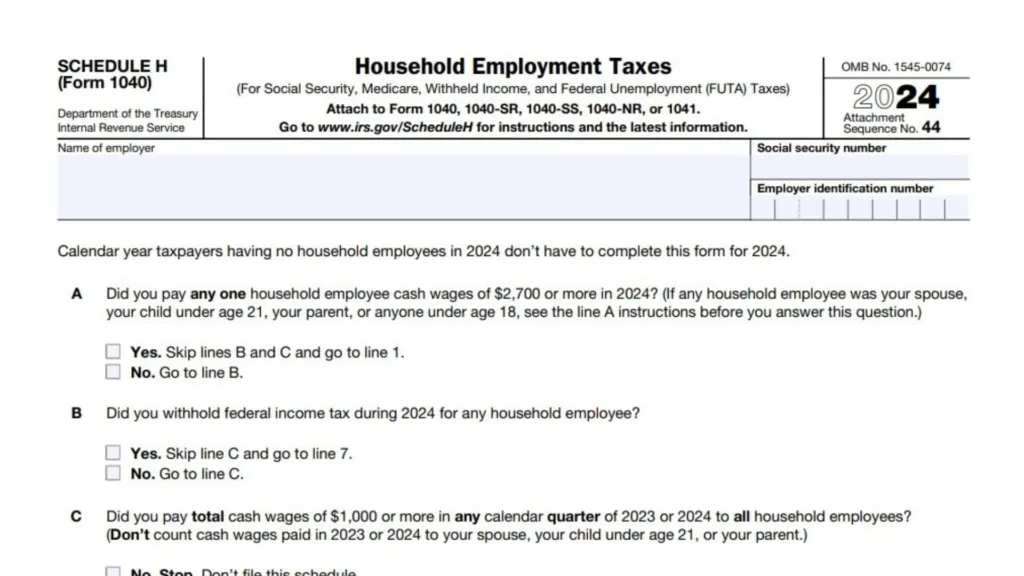
- If you pay a household employee $2,800 or more in a year (2025 threshold), report federal payroll taxes using Schedule H attached to your Form 1040.
Pro Tips and Best Practices
- Don’t classify your worker as an “independent contractor” unless they meet IRS and Illinois criteria—it’s a common mistake.
- Use reputable payroll services if you find the filings overwhelming.
- Always provide your employees with clear wage notices and written agreements—good for both compliance and peace of mind.
- Chicago employers: You must provide written contracts outlining duties, wage rates, and schedules in the worker’s preferred language.
- Workers’ compensation and timely tax filings protect you from lawsuits and government penalties.
FAQs
Q: Do I have to pay taxes for a part-time nanny in Illinois?
A: Yes—if you pay any household employee $2,800 or more in 2025 or $1,000+ in any quarter, you must pay Social Security, Medicare, and unemployment taxes, even for part-time help.
Q: How do I withhold Illinois income tax for a household employee?
A: Ask your employee to fill out Form IL-W-4, determine withholding from the Illinois tax tables, and remit taxes annually (IL-1040) or quarterly (IL-1040-ES) as required.


